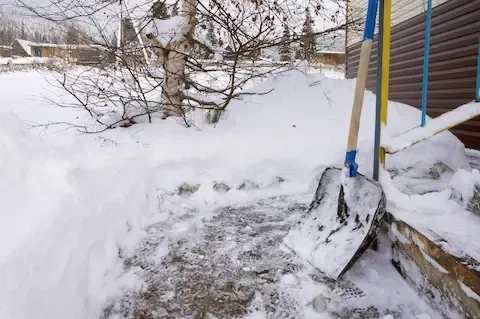
How Wide Should an Entrance Path Be in Dubuque IA Snow
For most Dubuque, IA homes and businesses, an entrance path should be cleared to a minimum width of 36 inches. This meets ADA accessibility guidance and allows a person using a wheelchair or walker to pass comfortably. For higher-traffic entries, commercial buildings, or situations where two people may need to pass each other, clearing to 42–48 inches is the better standard. Dubuque winters regularly produce heavy snowfall and compacted drifts, so planning your cleared width before a storm — not during — makes a real difference in keeping entrances safe and accessible.
What Is the Minimum Path Width Required for Accessibility?
The ADA (Americans with Disabilities Act) sets the baseline accessible path width at 36 inches for pedestrian routes. This applies to commercial properties across Iowa, including businesses in Dubuque's downtown corridor and along busy streets like Central Avenue and University Avenue. For residential properties, there is no strict legal mandate, but the 36-inch standard is widely recommended by snow removal professionals as the practical minimum. Anything narrower than 36 inches risks excluding people using mobility aids, creating liability concerns for property owners, and failing basic safety expectations during Dubuque's winter months.
When Should You Clear Wider Than 36 Inches?
Thirty-six inches is the floor, not the target. Consider clearing wider when:
- Your property receives frequent visitors — multiple people arriving simultaneously need room to pass without stepping into snow banks.
- You operate a business or rental property — commercial and multi-unit buildings in Dubuque carry higher liability exposure if entrances are inadequate.
- A household member uses a wheelchair, walker, or scooter — 42–48 inches provides the maneuvering clearance these devices actually require.
- Your path connects to a parking area — vehicles, door swing clearance, and foot traffic together demand a more generous width.
- You have steps or a raised entry — narrower paths leading to stairs become bottlenecks and fall hazards when ice forms at transitions.
For most Dubuque residential properties, clearing 42 inches is a practical and realistic goal that accommodates nearly every scenario without requiring excessive extra effort.
How Does Dubuque's Climate Affect Path Width Planning?
Dubuque sits along the Mississippi River bluffs, and its geography creates unique snow and wind conditions. Blowing snow off the river can refill a cleared path within hours. The city averages over 30 inches of snowfall annually, with storms frequently producing 4–8 inch accumulations. When heavy snow is packed tightly by foot traffic or freeze-thaw cycling — common in Dubuque from December through March — a path that started at 36 inches can compress to something much narrower at ground level due to built-up ice edges.
This is why many experienced local crews clear slightly wider than the target width. Clearing to 40–42 inches when the target is 36 gives you a buffer as the season accumulates compacted ice along path edges. It also makes re-clearing after subsequent storms faster, since the base width is already established. Our Entrance Snow Clearing service accounts for this seasonal buildup by setting proper path widths from the first clearing of the year.
What About Path Width for Steps, Ramps, and Transitions?
The width question becomes especially important at transitions — where a flat walkway meets steps, a ramp, or the threshold of a door. These are the highest-risk zones for slips and falls during Iowa winters. At steps, ADA guidance recommends maintaining the full accessible width through the entire approach, not just the flat run. If your steps are only 30 inches wide, clearing the approach path to 36 inches doesn't fully solve the accessibility problem.
For properties with ramps — increasingly common in Dubuque's older neighborhoods like the Langworthy Historic District, where retrofitted accessibility features are common — the ramp surface itself must be fully cleared, including at least 6 inches beyond each side edge to prevent wheel or foot slippage off the edge into snow. Transitions from asphalt driveways to concrete walks also tend to collect melt and refreeze, narrowing the usable surface further than it appears.
How Do You Measure and Mark the Right Width Before Shoveling?
A practical method used by professionals is to stake or mark path edges before the first significant snowfall of the season. Drive a stake or brightly colored driveway marker at each edge of the intended path at your entry. This gives shovelers and plow operators a reference point when snow obscures surface features. Without markers, it's common to unconsciously narrow a path by 6–10 inches on each side simply because there's no visual guide.
For homeowners doing their own clearing, measuring 36 or 42 inches from your door or step edge and placing a marker at the far edge of where you want the path gives you a consistent target every time. This is especially useful after heavy overnight storms when drifting can make the original path location unclear.
If you're curious about the full sequence for entrance clearing — from pre-treatment to final salting — our entrance clearing primer covers the complete process step by step.
Are There Local Dubuque Ordinances About Path Clearance?
Dubuque property owners are required under city ordinance to clear public sidewalks adjacent to their property within a set timeframe after snowfall ends — typically 24 hours. While the ordinance specifies that sidewalks must be cleared, it references the full usable width of the sidewalk rather than a specific number of inches. In practice, this means a path that only clears a 12-inch strip down the center of a 48-inch sidewalk would not meet compliance standards and could result in a warning or fine from the city.
For entrance paths on private property — your walkway from door to driveway or street — local ordinance does not specify a minimum width. However, liability law in Iowa means that if a visitor is injured on an inadequately cleared path, the property owner bears responsibility. Clearing to 36 inches minimum is the defensible standard in that context.
